Welcome to our new Instron Community Blog hosted by Instron. It is a compilation of the freshest, brightest, most-talented minds that Instron has to offer. The world of materials science is so vast and encompasses the broadest range of industries, materials, and challenges that no one person can possibly possess all the knowledge required to be the resident expert – or master of materials science. It takes a small army behind the scenes collaborating and sharing technical know-how, experiences, and ideas to present the most accurate, relevant, and timely information to you – our readers.

We invite you to tell us who you are, share your stories and talk about your experiences. Join the Instron Community.

Tuesday, February 14, 2012

Going to MD&M West on Valentine's Day?

If you're attending MD&M West in Anaheim, CA, be sure to stop by our booth (#2478) and visit with our crew: Karl Malchar, Theresa Smith, Jim Ritchey, Elena Mangano, and Chuck Gleason.

What better way to celebrate Valentine's Day than putting hearts to the test ... gooey and candy hearts that is, NOT a real human heart!

We performed a few compression tests to measure the force each type of heart could withstand before breaking or "smooshing". Take a look at the videos and give us your best guesstimate on the results. For every correct answer (or answers that are close), we'll send you a gooey Instron heart of your own (who doesn't want one?!?!).

Candy Hearts Part 1
Candy Hearts Part 2
Read more

Friday, February 10, 2012

Free Whitepaper on Mechanical Testing of Medical Impants

Implants and the materials used for their production undergo extensive tests, which include the evaluation of the static and dynamic mechanical properties of the raw materials, components, and systems. Many of these tests are internationally standardized; other testing procedures are specific to a given application. In all cases, advanced testing instruments and clamping fixtures along with flexible, programmable testing software help in the determination and analysis of the relevant data.

Stents are small tube-like medical devices, usually constructed of a biocompatible stainless steel or metal alloy, which are used by surgeons to widen or unblock clogged arteries to help restore normal blood flow and reduce risk of heart attack. Today, stenting is a common practice, making up more than 70% of the total coronary angioplasty procedures.

This is just a snippet of information you'll find inside the Mechanical Testing of Medical Impants article written by Toby Kemp, Jim Ritchey, and Erik Schmidt-Staubach. Download the free whitepaper to read more on the extensive range of testing applications.
Read more

Wednesday, February 8, 2012

30 Years and Counting ....

This month, we're featuring Randy Riddle, one of our very own Application Engineers. Not only is he a family man, a grandfather to three beautiful granddaughters, and the Mayor of Grove City, PA since 2004, but he has found the time to fit in 30 years of service at Instron.

Q: When did you first join Instron?
A: I started working at SATEC in January 1982 and then became employed by Instron after both companies merged in 1998.

Q. During your 30-year tenure, you've held a variety of positions within the company. What was your favorite and why?
A: I really enjoy working as an applications engineer. Using my engineering background - including my attention to detail - I use these skills in the selling/quoting process and in dealing directly with my customers. Also, I love to draw, so when I worked as a mechanical project engineer, I was able to create new products for SATEC/Instron.

Q: What are a few of your favorite moments?
A: The first one that comes to mind is the project I worked on with Steve Somple. We worked on the drawings used to develop an electromechanical machine. It was quite an experience to be on a team developing a new product line. The other moment that comes to my mind is when we found out that Instron had acquired SATEC. I was actually at a tradeshow, representing SATEC, with the Instron stand in the next row. At this time, we were competitors. However, all of us representing our respective companies learned at the same time of this merger. Well, you can say that definitely broke the ice for our conversation!

Q: What do you like best about working at Instron?
A: I really like that Instron is a smaller-sized company, giving us all the opportunity to know most, if not all, of our coworkers. I've enjoyed the various interactions I've had with our global coworkers. I wouldn't really have this opportunity to do so at a larger company.

Q: What was the biggest change you've experienced?
A: Definitely the SATEC acquisition by Instron. Not only did this provide opportunities for growth, but we now had the opportunity to share customer databases and offer our specific product line to many more potential customers.

Q: What is the most interesting thing you've been a part of at Instron?
A: Being a part of our Industrial Products Group (IPG) business team. This groups makes a collective effort and promotes our productline to create a happy customer with positive feedback.

Q: What has working at Instron taught you over the years?
A: To pay attention to the detail - even those that seem so small-  starting with the very first contact you have with a customer all the way through to the machine implementation and beyond. A customer should not want or need anything.

Thanks so much for your time, Randy, today and for the last 30 years!

If you have a question for Randy, please leave it below.
Read more

Tuesday, January 31, 2012

Predicting the Properties of Virtual Materials

Historically, the properties of any new material have had to be determined empirically. It can take many years to transition a material from discovery to a commercial product, which is too slow, given the range of urgent problems that advanced materials can help us solve.

A groundbreaking new tool called the Materials Project uses supercomputers to predict the properties of inorganic compounds that do not yet exist. This tool lets researchers and engineers characterize many properties of each compound. The results are organized into a searchable database. The data lets researchers evaluate the compounds and quickly determine the more promising avenues of research and development to follow.

The time frame for materials to move from discovery to market is lengthy; 10 to 20 years is not unusual. This is mainly due to the continued dependence on scientific intuition and empirical experimentation in materials research & development programs. For example, it can take months of work consulting data tables, performing calculations, and carrying out lab tests to create a simple phase diagram showing the temperatures and pressures at which a complex compound would be solid, liquid, or gas. Furthermore, even when materials have already been studied and the information exists, the results are often scattered across many discrete databases, and therefore, impossible to find.

The Materials Project originated from the Materials Genome Project started in 2006 by Dr. Gerbrand Ceder, the R.P. Simmons Professor of Materials Science and Engineering at Massachusetts Institute of Technology (MIT). The goal was to use computational modeling to design and investigate new materials by mapping the relationship between material's structures and their physical and chemical properties.

Information, such as the phase diagram, can now be generated in a matter of minutes. It is possible to predict a material's properties theoretically before it has even been manufactured, greatly reducing the time spent on testing and development. The site's tools can quickly predict how two compounds will react with one another, what that composite's molecular structure will be, and how stable it would be at different temperatures and pressures.

With the help of supercomputers at the Department of Energy's National Energy Research Scientific Computing Center (NERSC), the Berkeley Lab, and systems at the University of Kentucky, the Materials Project database currently forms a central repository that contains the structural and energetic properties of almost 19,000 inorganic compounds with more added daily.

Already scientists are using the tool to work with companies interested in making stronger, corrosion-resistant lightweight aluminum alloys, which could make it possible to produce lighter weight vehicles and airplanes. The tool has been successfully used for the prediction and discovery of materials used for clean energy technologies, including lithium ion batteries, hydrogen storage, thermoelectrics, fuel cell electrodes, and photovoltaics.

Cedar also suggests that the tool could offer improvements in technical education. When professors set up experiments to help students learn specific principles, they had to pick easy examples with known outcomes. Now, it's possible to set much more challenging theoretical exercises.

The web-based search application lets users search for information on specific chemical formulas or to customize their searches by chemistry, composition, or property.  The below image shows part of the result of one of these searches.


The Materials Project is available for use by anyone, although users must register in order to spend more than a few minutes, or to use the most advanced features.

The importance of fast and accurate development of new materials is underscored by the inclusion in the Federal FY12 budget of $100 million to launch the Materials Genome Initiative, with funding for the Department of Energy, the Department of Defense, the National Science Foundation, and the National Institute of Standards and Technology. The initiative will fund computational tools, software, new methods for material characterization, and the development of open standards and databases with the goal of doubling the speed with which new materials are discovered, developed, and manufactured.

Innovative computational tools, such as the Materials Project, will form an important part of the future of materials science and the revitalization of American manufacturing.

Sources
1. Technology Review (MIT) Jan/Feb 2012 – “Can We Build Tomorrow's Breakthroughs?” - David Rottman www.technologyreview.com/article/39311/?mod=chfeatured
2. US Dept. of Energy Berkeley Lab, Nov 3, 2011 – “Supercomputers Accelerate Development of Advanced Materials” - Julie Chao newscenter.lbl.gov/feature-stories/2011/11/03/supercomputers-accelerate-development-of-advanced-materials
3. Whitehouse.gov Blog, June 24th 2011 – “Materials Genome Initiative: A Renaissance of American Manufacturing” - Tom Kalil and Cyrus Wadia www.whitehouse.gov/blog/2011/06/24/materials-genome-initiative-renaissance-american-manufacturing
Read more

Grip it Right

Gripping a specimen correctly is important if you want to acquire accurate test data. To most test operators, this is second nature.
  • Make sure the grips and specimen are well aligned
  • Make sure the grips and grip jaws are suitable for the material being tested and the test loads expected
  • Make sure the grips and grip jaws are clean and undamaged


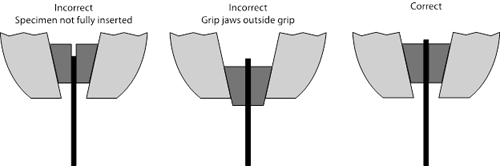
However, often overlooked is ensuring the specimen is correctly inserted into the jaws, particularly when using wedge-type grips. You should insert the specimen so that it is centered and that it contacts the full length of the grip jaws. Further, the grip jaws themselves, once gripping the specimen, should not protrude below the lower face of the grip. If they do, then you should select a smaller grip for the test. See the illustration below. If a test is performed with a partially clamped specimen or with the grip jaws protruding below the lower grip face, the grip jaws can experience severe twisting loads leading to their failure.
Read more

Question from a Customer

Q. What is a “Virtual Measurement”?

A. Materials testing software uses two types of measurements to provide resuts or input for result calculations; physical measurements and virtual measurements.

A physical measurement is measurement data that is provided directly from a transducer that is monitoring the specimen, such as a load cell or an extensometer. A virtual measurement is measurement data that is provided as the result of a calculation. The inputs to the calculation can be one or more physical measurements, user-entered values, or previously calculated results.

A simple example of a virtual measurement is tensile stress, which is calculated as load (a physical measurement provided by the load cell) divided by the cross-sectional area of the specimen (usually a user-entered value).

A commonly overlooked virtual measurement is corrected extension, which adjusts values of crosshead or actuator extension to correct for compliance, or elastic stretch, of the testing instrument and load string components. Corrected extension is calculated as extension (a physical measurement provided by an encoder or LVDT) adjusted by a value taken from a compliance data file.
Read more

Friday, January 27, 2012

Protecting Mobile Devices from Impact Damage

I find it difficult to walk down the street, or in the mall, without having to move out of the way to avoid bumping into someone who is looking down at their phone - either playing games, sending a message, or watching a video. And during seminars, I notice that more and more attendees are not only bringing their laptops and smartphones, but also have in their bags a touchpad. Technology is evolving and conveniently giving us the world at our fingertips ....

But what happens when one of these expensive gadget falls to the hard floor or is thrown into your bag with your keys, pens, and other objects that can scratch?

Check out this video to see what one company is doing to help protect your investment.

Read more